
In this final post in the Summer Series on Strategic Design, we look at how to bring it all together in practice.
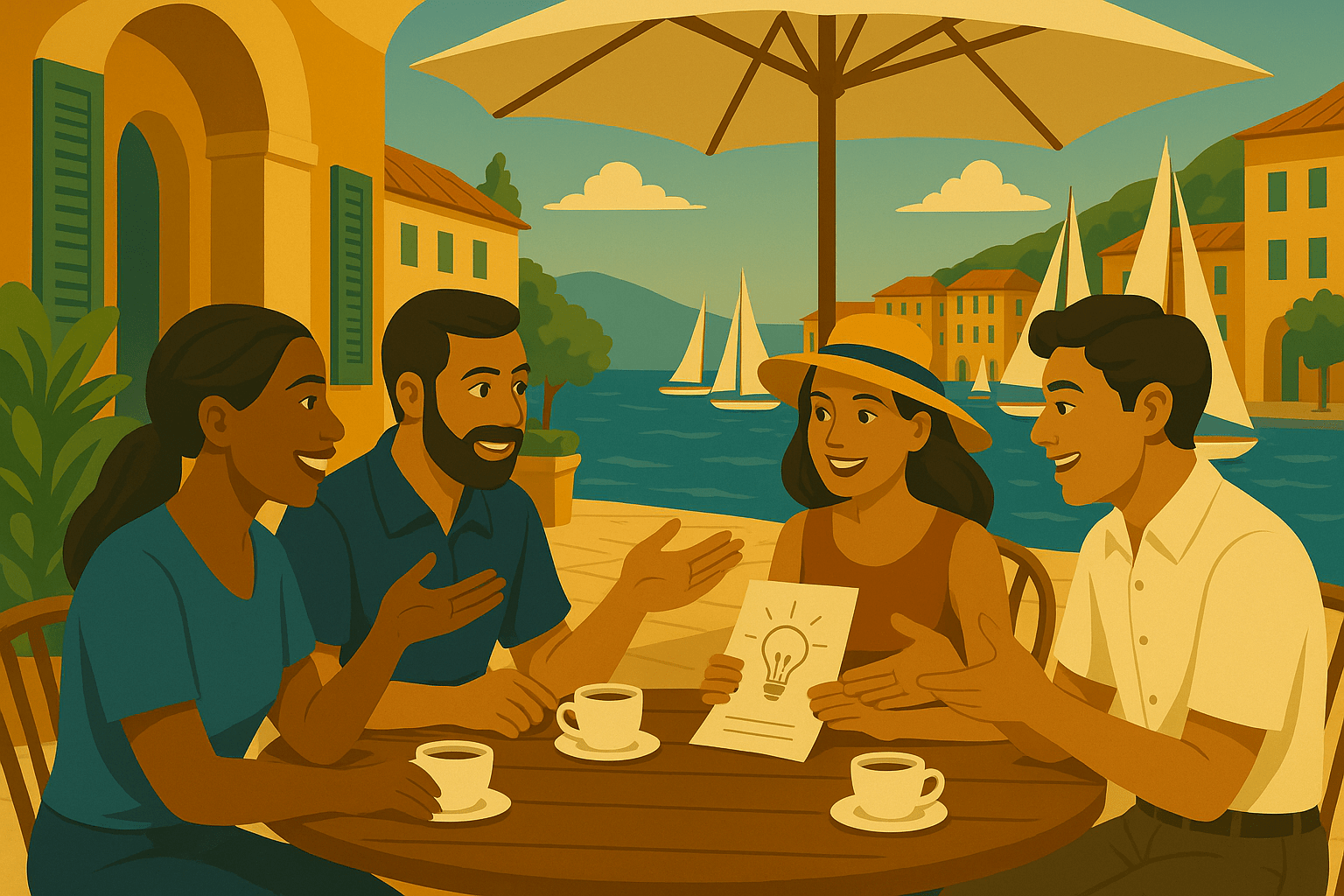
Drawing on the themes of summer, sailing and sunshine on the Mediterranean, we are going to set the table for engaging in a strategic design activity. While not a blueprint, it does give a sense of what’s done and how.
But first, let’s begin with a summary of what’s been discussed so far on our journey.
Strategic Design: A Primer and Review
Strategic design represents a fundamental shift from traditional planning approaches to an adaptive methodology that embraces complexity—the unpredictable outcomes arising from interconnected systems that can’t be reversed once they evolve—as a navigable reality requiring pattern recognition over problem-solving. This approach moves beyond common strategy misconceptions (confusing it with goals, missions, or tactics) to focus on coherent choice-making. This shift delivers a substantial return on investment (ROI) through improved alignment, faster decision-making, and enhanced innovation capacity.
If this is to be successful, leaders need to combat “strategy blindness” by developing weak signal detection skills through expanded information networks and pattern recognition, while embodying three essential qualities: humility (recognizing the limits of individual knowledge), inquiry (asking generative questions), and agility (learning from experience and adapting quickly).
We also looked at the strategic design framework that encompasses the key elements that, together, make strategic design different from other approaches to planning. It also identifies the core elements of a complexity-informed plan and process. The framework integrates four core elements—intent (shared stakeholder vision), imagination (foresight-informed possibilities), production (tangible prototyping and implementation), and learning (embedded evaluation)—while applying systems thinking to set appropriate boundaries and understand transformation as behavioural and systemic change guided by robust theories of change.
Strategic design includes an element of designing for possible futures. Strategic foresight methods like horizon scanning, scenario planning, and backcasting prepare organizations for multiple possible futures rather than attempting prediction, while design-driven evaluation embeds learning directly into program fabric rather than treating it as an afterthought. Together, these elements create a comprehensive approach that treats strategy as an emergent practice combining systems awareness with design methodology. This enables organizations to navigate uncertainty through continuous adaptation rather than seeking control over complex environments—particularly valuable for human-centred sectors.
These human living systems are where traditional cause-and-effect models fall short. It’s why strategic design brings intention to our work, while nurturing our ability to sense, adapt, and learn as fast as change comes at it.
In short, it’s strategy making for complexity.
Making Strategy

What we’ve covered so far is what strategic design is. How is it done? While there isn’t a playbook or a specific step-by-step guide, there are some consistent activities. We’ll focus on those.
- Context and Boundary Setting. This first step is exploring the boundaries of our design scope. This includes the time horizon you’re looking to develop plans for, the actors and relationships involved in the process, including those affected by the strategy, and the necessary people, resources, time, and other constraints that will shape the process. This is part of systems thinking, and it allows you to understand who and what are involved to scope the process and also shape what kind of knowledge you need to inform the work.
- Background Research. Now that we have our context set, we need to know about what’s happened and what’s going on now. Strategy is about the future, but knowing where you’ve come from (as an organization or as individuals) and the baggage you’re packing matters. Background research can help identify path dependencies in an organization, habits, power structures, and levers that can be activated for action.
- Engagement. Strategic design involves working with those affected, enabled, and embodied in the very plans we make. An engagement strategy can involve various levels of engagement from deep co-design to consultation, and the level you use is dependent on many factors, including resources and the cultural aspects of your organization. Higher engagement, more often, with greater time, care, and attention will almost always be better than less. Tactically, this can involve everything from surveys to focused interviews to public forums and any other means of gathering authentic, honest and open input.
- Sensemaking. This process of understanding what it all means — the background, foresight, and direct consultation data. This is an active process where we collectively reflect on what’s been heard and seen, interpret, and frame the findings in the context of what is being done. This process has been discussed in more detail in earlier posts.
- Envisioning. This part is about connecting the vision for what the organization wants for itself (it’s winning aspiration, to quote Roger Martin) with the data that you gather. This is where your foresight scanning comes in and bringing in data from trends, scenario plans, and other exercises aimed at helping ‘see’ what might be coming and then developing a means to envision what success — and the pathway to that place — looks like within these different hypothetical, but evidence-informed situations.
- Assumptions Testing. Another Roger Martin suggestion is to use the question “What would have to be true?” To guide our assumptions-testing. When we answer this question, we determine some of the fundamental assumptions that underlie many of our plans. For example, if the aspiration of an organization is to double its services in the next five years, there may need to be certain resource requirements in place today to do that. If not, then this assumption doesn’t hold. A strategic plan has to be grounded in reality.
- Tactics and Principles. Tactics are not strategy, but they are still the means to get from A to B. Adaptive, purpose-designed approaches might rely on a variety of tactics to support strategy. Principles are those touchstones that will determine the appropriateness and timing of use of certain tactics. Principles can help guide decision-making in the face of uncertainty. Articulating principles can be a way to make values practical, which can be the means to making them actionable.
- Support and Learning Systems. This is where our evaluation system comes in. Developing a system for learning, evaluation, and feedback is critical to determining the success of a strategy. Working in a living system means attending to patterns and building a sensitivity to conditions to enable decision-making. Added to this are systems that support your decision-making, which can be spatial, policy, or habitual practices that encourage adaptive action.
- Articulate the story. The last part of the process is to tie this together and tell the story of the organization and where it will go (and how it will get there). Be specific enough to recognize important details, but not so much that it confines the story to one narrative. The reason is because the strategic implementation will be a story that unfolds over time with the plan as the guide. It’s very much like the plan and story for a road trip.
- Traps, Threats, SWOT, and Surprises. While not necessary to codify, it can be useful to include an articulation of the key threats, potential traps, and areas of opportunity that might emerge. A SWOT analysis can be useful here to recognize what people fear or see, and as a reference point when the unexpected comes up. It can identify scenarios where there was conscious or unconscious concerns ahead of time and allow you to trace back the assumptions and preconditions that might have contributed to them.
Strategic Design Practice

Strategic design is all about bringing together people, ideas, and systems in a pragmatic, visionary way. It blends more traditional strategy with systems thinking, evaluation, learning and sensemaking, and is guided by sound behavioural science. It draws on what we know about how people create things, how organizations are run, theories of change that lead to impact, and behavioural psychology.
This process is designed for complexity and living systems, not static organizational charts or rigid plans.
At a time when so much uncertainty, disruption and interconnected influences shape what we do, strategic design offers us a way through the complexity to the simplicity on the other side by creating a pathway to do our best work.
I hope you’ve enjoyed this year’s summer series looking at complexity and strategic design and find it useful. Happy Summer!
Please reach out if you want assistance implementing this approach within your association, network, or organization. I’d be happy to help you set your table.

This is fantastic Cameron! Thank you. I’ve added it to my facilitation resources page and shared it on my blog.
Hi Chris,
Thanks so much for your comments; I’m glad you like this. And thank you for sharing it, too. By all means use this and share this if it can help you or others. — Cameron
Pingback: August 4, 2025: tests and seasons – Chris Corrigan
Pingback: Fall Into Strategy: Crafting Effective Actionable Plans