As anyone reading this in 2026 (or beyond?) is aware of, Artificial Intelligence (AI) has dominated much of the public discourse on creativity, productivity, innovation, and workplaces. Much has been written, said, and shared about the many ways AI is influencing what we make, how we make it, and what the role of the human is when these ever-evolving tools are so powerful and capable of generating things that once could only be done by humans. Among all of this is something missing: human | being.
By this, I mean something that is distinct to humans — what it means to be and to express our humanity.
This is not as you might think; this is not just about whether or how humans make things, and whether what we make has any distinctive attribute that can’t be captured by AI. To that end, I’m unconvinced that – with time – we will be able to distinguish machine-made from human created. The technology and tools are far to advanced and evolving quickly enough that we’ll be able to tell. Aside from my word as an author and the trust you put in me, there’s no way to tell even today whether these words on the screen are human-authored.
But there’s something much more than what we make, but what is made through the making.
To reflext on that, let’s explore what designers – those who make things – think about AI and the practice of design.
The benefit of design is much more than what we make, but what is made through the making.
What Happens When Making Gets Easier?
Recently, DesignMeets held an event at OCAD University on Redesigning Design: What Happens When Making Gets Easier? The emphasis of the evening was on what AI means for educating designers and nurturing design practice through the lens of a panel comprised of those from many different facets of design. The event was co-sponsored with the Design Industry Advisory Council (DIAC) and sought to inspire conversations about what it means to create things when the tools and technology have transformed the practice of making.
The conclusions raised from the event were these (as noted in the web summary):
- Faster isn’t always smarter: AI can put design workflows into overdrive. But churning out more options doesn’t necessarily produce better decisions.
- The first rung of the career ladder is looking decidedly wobbly. As AI takes over entry-level tasks, educators and employers must rethink how emerging designers develop their skills and professional judgment.
- The real value of design isn’t always what gets delivered. Critical thinking, contextual understanding, ethical responsibility and collaboration separate professional design from simply producing a polished result.
- Making still matters. A lot. Generative AI can conjure convincing images in seconds. But understanding materials, mastering techniques and knowing how things actually work remain essential.
- Design has a new client: itself.The profession needs to rethink how it educates, mentors, operates and makes the case for its value in an AI-powered world.
What I was most interested were the last two of these. It’s here that I’d like to add and extend these points. In particular, my interest is in emphasizing the process of innovation and why AI isn’t – and can’t ever be – set up to produce specific outcomes because of what it means to make something.
Process as Outcomes: What Design Produces
Design is the discipline of innovation, therefore if we wish to innovate, we need to design. – Marty Neumeier
The push to innovate is usually the drive to make things better. It is, as Herb Simon said of design, the aim to devise “courses of action aimed at changing existing situations into preferred ones.”
These are the explicit outcomes of innovation, and the focus for most KPI’s, “impact metrics”, and change scores which reflect such outcomes. Business leaders speak of the return on investment for innovation or design, which includes what AI offers to the enterprise.
What these all miss is what people become through the act of making something. Design is built on three foundations: thinking, making, and deployment. Each of these has a transformative effect on the maker. It requires a set of skills and knowledge that can’t all be replicated by AI in the process of their use. By this, I mean that in creating something, there is a value for the creator over and above what they produced.
This comes from reflection in action.
In creating something, there is a value for the creator over and above what they have created.
Here are four of those benefits:
1. Failure, Success, and Context: Humans learn by doing things, observing, mimicking and integrating all of it together. Through this we learn what works, doesn’t work, and can gauge the reactions of those around us to learn from what might work. AI offers none of this, only a product. Absolute success or failure is rare in innovation; we might fail to produce an outcome, but then learn that what we generated is an improvement to another problem. The “discovery” of what became Viagra is one of the most profitable examples of that: by failing to treat one condition (heart conditions), the makers of the drug inadvertently managed to address another (erectile dysfunction).
To illustrate this further, the talk linked below from the late Sir Ken Robinson, points to how children aren’t concerned about failure in creating things, only possibility. This helps them learn through making.
2. Collaboration and Connection. AI doesn’t collaborate in any traditional sense. There’s nothing that connects people together through AI; its humans who might choose to use an AI to assist creation, but AI itself doesn’t collaborate. In the process of making things with and for people, we learn about ourselves (our strengths, skills, limitations, and preferences) and those we create with and for. These are unique to human making.
3. The Byproducts of Creation. In the process of making things, we learn about materials, our bodies, and the environment we make in (even if it’s digital). These are things that are picked up as byproducts of what we make. We learn about others, ourselves, and the situations we’re looking to address in ways that aren’t intended or designed, but just happen. These byproducts expand our understanding of the context we work in and the world around us. None of this comes with an AI-driven command system. It can’t — AI is linear, humans are non-linear.
4. Curiosity. By exploring through the materials and acts of working with them — digital, physical or social — we foster curiosity. Curiosity brings an enormous dividend to your organization by prompting your staff to ask questions and seek solutions rather than accept things as they are or settle for the outcomes of a specific project. Curiosity, when nurtured and supported by leaders, is a self-perpetuating innovation flywheel. And it’s pretty much free.
The process is also the outcome in innovation.
Increase the Innovation Dividend
The misleading promise of innovation is the final product. I argue that’s a poor metric. We know that many innovations fail for all kinds of reasons that extend far beyond the design. Great products fail to take off, while substandard ones get adopted or the status quo stays put, the very best we can do is set the systems and conditions to make something work. But within that there’s learning.
Learning and development — through things like developmental evaluation and reflective practice — is something that the art and science of making things brings. The innovation dividend is inspiration and deep learning about the products and systems that you’re producing. It’s so much more than what we’re creating — it’s what we become through the creations.
Increase your capacity to try things out — fail, succeed or anything in between — and learn from that and you’ll find that innovation and the design practice behind it pays off much more than any AI-driven process can. Sure, use AI, but know what you’re giving up and losing when its used to replace processes where people learn, connect, and create.
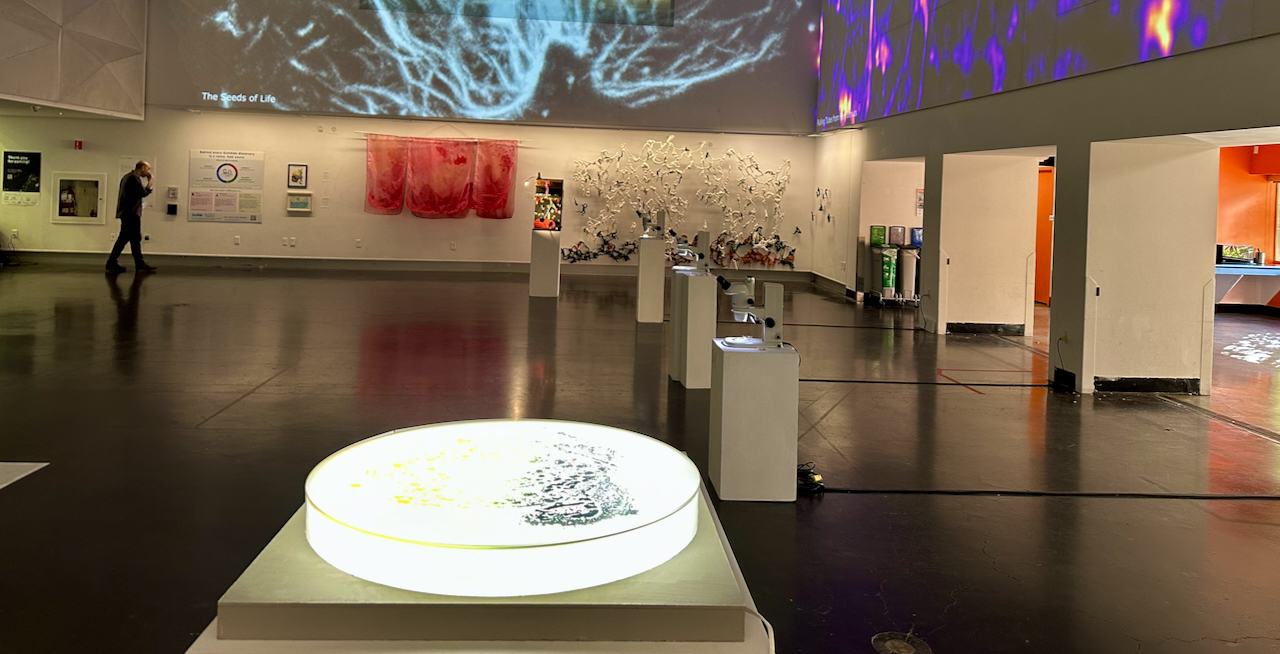
Photo credit: Cameron Norman — The Seeds of Life Innovation Exhibition, OCAD University and Sick Kids Hospital (2026)
Excellent post and title “What We Become Through Creation”. So true.